In 2026 Meaning Matters Again
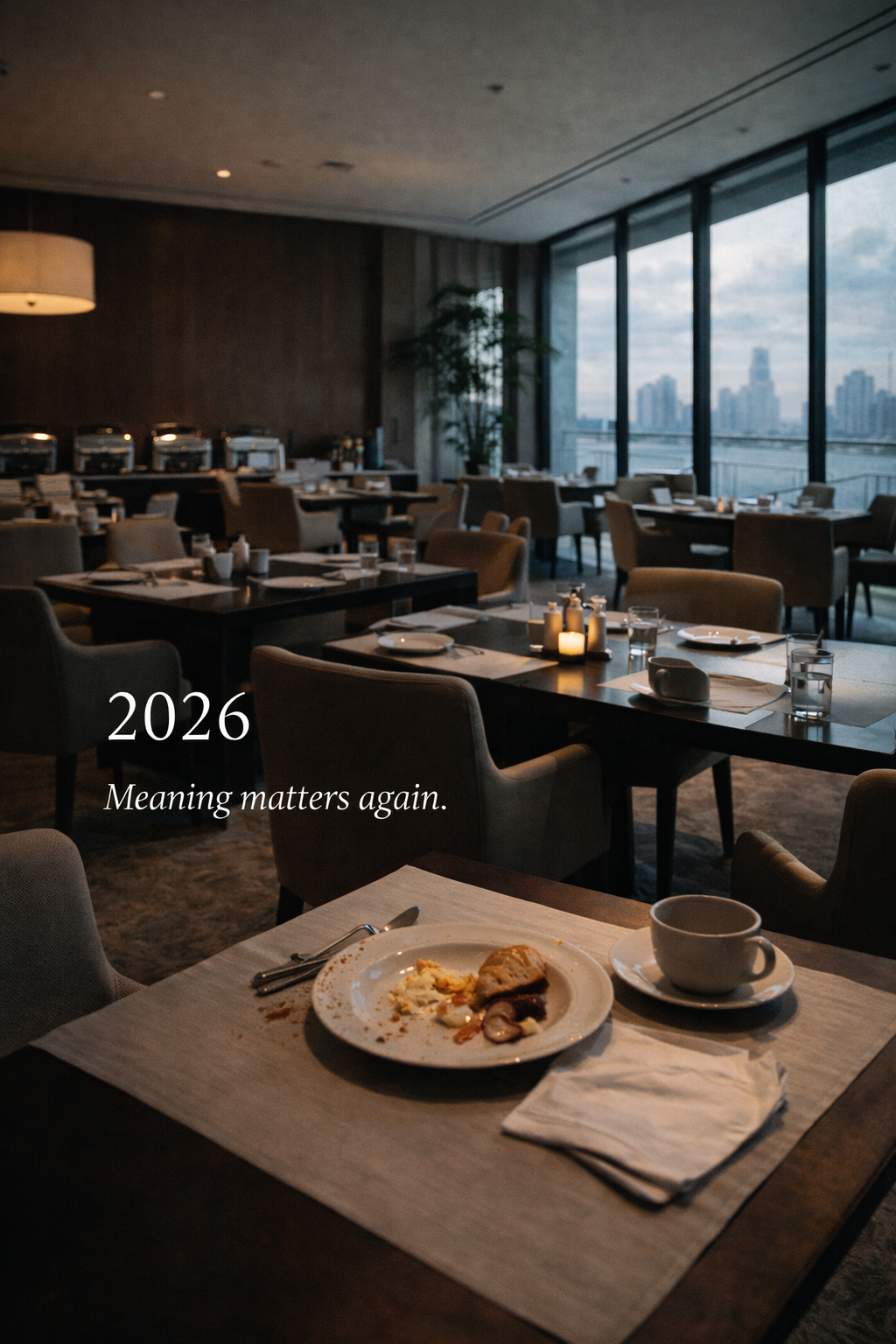
As we step into 2026, I want to wish you a very happy, healthy, and successful year ahead.
What follows is not a list of trends for the sake of prediction. It is based on what I am seeing across hotels, owners, teams, and guests. Commercial assumptions are being tested, guest behaviour is shifting, and long-standing operating and brand models are being exposed. Not through theory, but through choice, competition, and comparison. In most cases, these models are not being redesigned yet. They are being stretched, protected, and worked around.
Where differentiation still exists
Ultra-luxury will be the strongest growth area. Not because there are suddenly more wealthy travellers, but because genuine differentiation has become rare elsewhere. Across many brands, it is increasingly difficult to tell hotels apart through room design, food and beverage, or brand experience. Too often, location and the building itself have become the only real differentiators.
In ultra-luxury, the difference remains operational and experiential. Rooms are not just well designed; they are better detailed and better maintained. Food and beverage is led by talent, rather than talent recruited to fit an average wage budget. Service is built around the guest rather than a rigid SOP or sequence of service. Guests who can afford it are actively trading up, and increasingly moving their loyalty, towards places that feel intentional rather than copied.
How guest behaviour is really changing
At the same time, the gap between five-star and four-star hotels will continue to narrow. Cost cutting, diluted service models, and over-standardisation have weakened the justification for premium rates. Brand loyalty alone is no longer enough to hold guests when the experience feels interchangeable. Guests are more informed, more price-aware, and more willing to move to a different brand when value or experience is clearly available at other hotels, direct competitors, indirect competitors, or alternatives such as Airbnb.
Saving money does not mean sacrificing experience. Guests are making sharper choices. More trips, often shorter stays, but better decisions about where time and money are spent. Less indulgence in the middle, more intention at either end of the scale. This is not disloyalty; it is discernment shaped by experience, value, and trust.
When brands stretch, meaning thins
In response, more hotel brands will continue to merge with or overlay long-stay and residential-style models, blurring the line between hotels, serviced apartments, and branded living. The opportunity is clear, but so is the risk. When stays are longer and expectations shift, brand meaning is tested far more directly.
Many hotel brands have become too broad. While groups work hard to protect the positioning of acquired brands, the same operating logic, commercial decisions, and decision-making structures often sit beneath them all. Over time, brands gradually start to look and feel the same.
The issue is not guest promise alone, but uniqueness. When design language, room layouts, food and beverage thinking, service models, and even talent decisions begin to align, individuality fades. In practice, many guests increasingly see the parent brand before they see the individual flag. Hyatt is often perceived as a Hyatt hotel rather than a brand in isolation, and the same pattern now applies to Marriott and many of the top 15 hotel brands worldwide.
There have been successful attempts to create separation. EDITION is a strong example of a brand that initially established a clear identity and sense of difference. However, as portfolios expand and structures are reshaped, that separation becomes harder to sustain. Recent restructuring risks eroding the very elements that made it distinct.
As groups continue to expand across hotels, long-stay, residential, and hybrid models, the challenge will not be scale, but meaning. Brands that stretch too far risk competing on availability and rate, rather than on identity, leaving guests loyal to location and price rather than to the brand itself.
What loyalty, leadership, and technology will actually do
Loyalty itself will be redefined. Some brands will strengthen their programmes, but many will shift value away from elite tiers and towards broader participation. The focus will move from accumulation to access, from points to moments, and from hierarchy to relevance. Guests will reward brands that recognise them as individuals, not just members.
AI will quietly enable this shift. Used well, it allows hotels to personalise at scale and support teams in treating every guest as their best guest, end to end, without adding operational burden. Used poorly, it will simply automate mediocrity.
Senior roles with heavy administrative weight will continue to be reduced. Not because experience no longer matters, but because AI will absorb much of the reporting, forecasting, and analysis that once justified layers of management. Leadership will be defined more by judgement and accountability, and less by administration.
Decision-making will shift as well. Fewer decisions will be made in isolation of AI, with leaders increasingly using data-driven insight to inform choices rather than relying solely on intuition, hierarchy, or ego.
What will increasingly be expected, not applauded
Marketing will move away from polished, generated content towards real guest voices. As AI-generated content saturates channels, authenticity will carry greater emotional equity. Real experiences, imperfect moments, and genuine stories will matter more than produced narratives.
Environmental and sustainability considerations will continue to scale and play a growing role in decision-making. Not as a trend, but as an expectation. Guests, owners, and investors will increasingly demand evidence, credibility, and measurable outcomes. This is why we have built practical tools on captivateconsultants.ae that move the conversation away from statements and towards measurable impact.
If any of this reflects what you are seeing, I would encourage you to visit the website and explore those tools further. Alongside this, I am actively working with hotels across the GCC, Europe, and Africa that want to replace traditional leather in-room items with 100 percent plant-based alternatives, without compromise to design, durability, or guest experience.
2026 will reward those who are willing to look honestly at how hotels operate, what guests truly value, and where change can create both meaning and margin.
Thank you for reading. I look forward to the conversations ahead.
Michael